March 17, 2026


By N7 Data Services LLC
Published: March 16, 2026
Cybersecurity used to be simple, or at least simpler. Organizations built strong network perimeters, deployed firewalls, and assumed that anything inside the network could be trusted. Today, that model no longer works.
Cloud adoption, remote work, SaaS applications, and increasingly sophisticated cyber threats have fundamentally changed the risk landscape. Attackers no longer need to “break in” from the outside; stolen credentials, compromised endpoints, and third‑party access often give them a legitimate-looking way in.
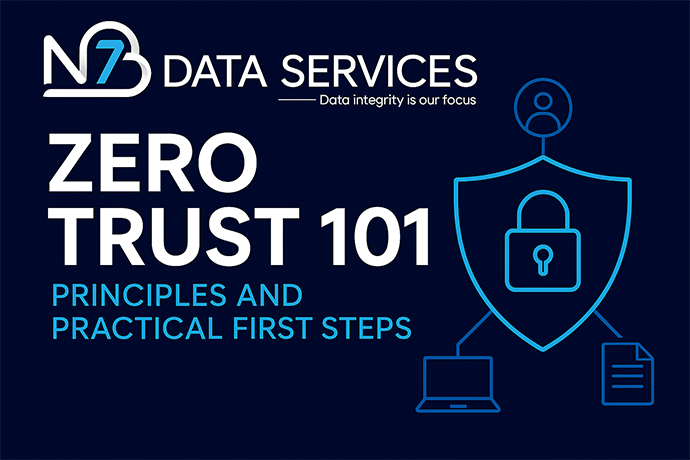
This reality has driven the rapid adoption of Zero Trust, not as a product, but as a security strategy. In this article, we’ll cover the core principles of Zero Trust and outline practical first steps organizations can take to begin their journey.
At its core, Zero Trust is a security model based on one simple idea:
Instead of assuming trust based on network location (inside vs. outside the firewall), Zero Trust treats every user, device, application, and request as untrusted by default, even if it originates from inside the organization.
Access is granted only after verifying identity, device health, context, and least-privilege authorization, and that trust is continuously re‑evaluated.
Zero Trust is not a single technology or vendor solution. It is a framework that influences how identity, devices, networks, applications, and data are protected.
While implementations vary, most Zero Trust strategies are built on a common set of principles.
Every access request should be authenticated and authorized using multiple signals, such as:
This is why identity becomes the new security perimeter in a Zero Trust model.
Users and systems should only have access to what they need, and nothing more.
Least privilege means:
Reducing excessive privileges significantly limits the blast radius of a breach.
Zero Trust operates under the assumption that attackers may already be present in the environment.
This mindset drives:
Rather than focusing only on prevention, Zero Trust emphasizes resilience.
Trust is not permanent. Zero Trust requires ongoing evaluation of:
If risk increases, access can be limited, challenged, or revoked in real time.
Before getting into implementation, it’s important to address a few common myths.
“Zero Trust means trusting no one.”
Not exactly. Zero Trust is about verifying trust continuously, not eliminating productivity or collaboration.
“Zero Trust is too complex for small or mid-sized organizations.”
While enterprise implementations can be complex, Zero Trust principles scale well and can be adopted incrementally.
“We need to replace everything to implement Zero Trust.”
In most cases, Zero Trust builds on existing identity, endpoint, and security investments.
Zero Trust is a journey, not a switch you flip. The most successful programs start small, focus on fundamentals, and evolve over time.
Here’s where N7 Data Services typically recommends starting.
Identity is the cornerstone of Zero Trust.
Key first actions:
If you do only one thing, make it MFA, this single step can prevent a large percentage of credential-based attacks.
You cannot protect what you don’t know exists.
Start by answering:
This visibility enables informed access decisions and exposes unnecessary or risky access paths.
In a Zero Trust model, access decisions consider not just who the user is, but what they’re using.
Initial steps include:
Rather than trying to fix everything at once, focus on your most sensitive assets:
Reduce standing admin privileges and require elevated access only when needed.
Traditional network access often gives users far more reach than required.
A Zero Trust approach:
This can often be done gradually, starting with a small set of critical applications.
Visibility is essential to Zero Trust.
Ensure you can:
Even basic improvements in monitoring can dramatically reduce dwell time during incidents.
When implemented thoughtfully, Zero Trust is not just a security improvement, it’s a business advantage.
Benefits include:
Zero Trust can feel overwhelming, especially when balancing security, usability, and budget. At N7 Data Services LLC, we help organizations translate Zero Trust principles into practical, achievable roadmaps aligned with real-world business needs.
Whether you’re just getting started or looking to mature an existing security program, we focus on:
Zero Trust is not about perfection, it’s about progress. By starting with identity, visibility, and least privilege, organizations can meaningfully reduce risk without disrupting operations.
The question is no longer if you should adopt Zero Trust, but where you should begin.
If you’re ready to take the first step, N7 Data Services LLC is here to help.